

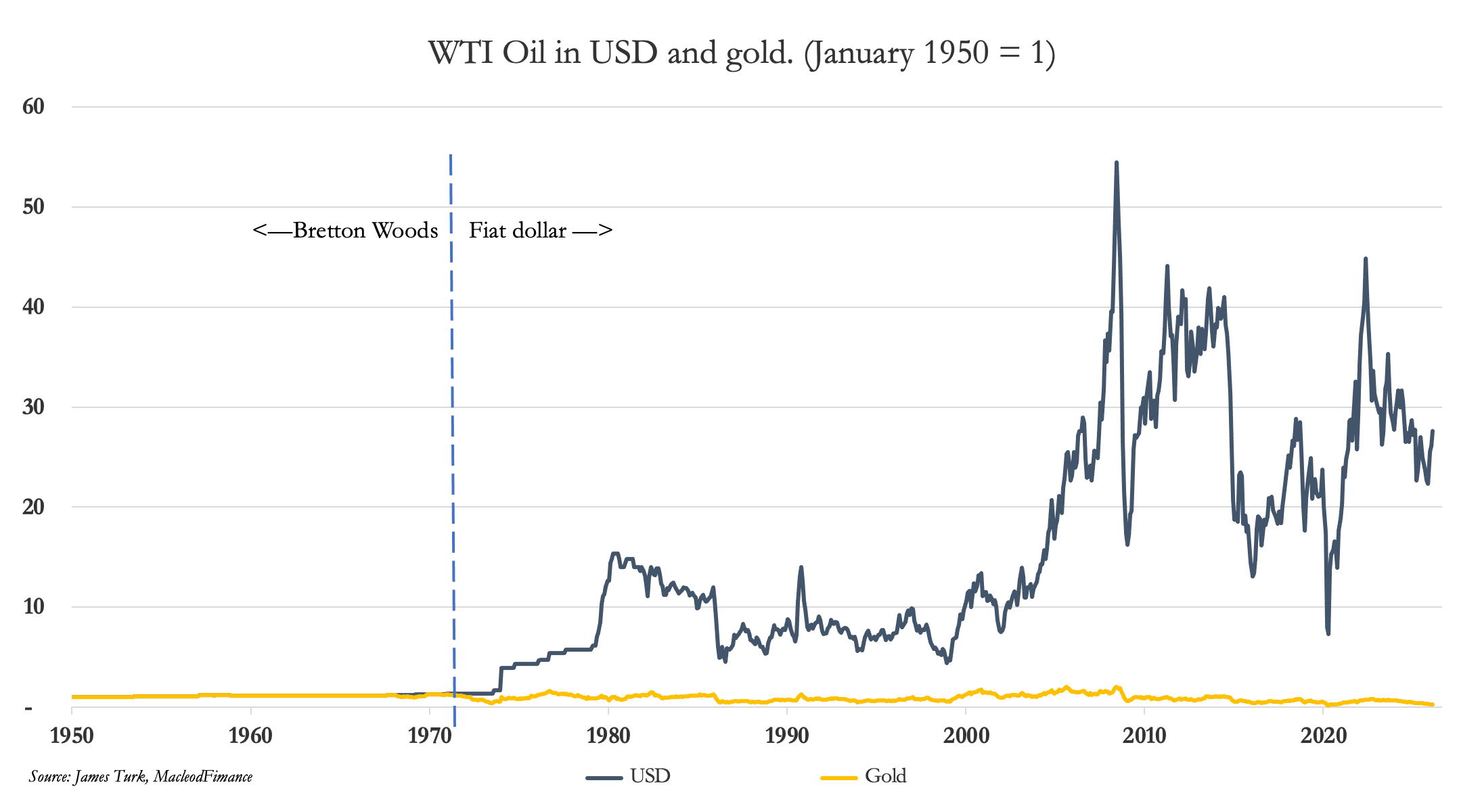
The chart above illustrates the point. Under the Bretton Woods gold standard when the US dollar was exchangeable between central banks and governments at $35 for an ounce of gold, oil prices were remarkably stable. Originally fixed at $2.57 per barrel and 2.8829 barrels per gold gramme in 1950, it only rose to $3.56 per barrel and declined to 2.58 barrels per gold gramme when the Bretton Woods agreement was finally abandoned and the dollar became a fiat currency.
Even that small decline measured in gold can be laid at the door of increasing dollar instability, leading to the establishment and failure of the gold pool in the 1960s which was an attempt to contain a run on the dollar.
Following the abandonment of Bretton Woods, the oil price became extremely volatile, with the price rising to over $70 today, a multiple of over 27 times the 1950 oil value. Meanwhile, priced in gold, oil is only 26% of its post-war value.
