

In this article, after examining the fundamental outlook for the relationship between gold and fiat currencies, we look at the psychology behind investing, and why it shouldn’t apply to gold. It concludes that there’s growing evidence of gold’s next leap higher, reflecting an acceleration in credit risk and fiat currency devaluation.
Regular readers of MacleodFinance will know that it is not the purchasing power of gold which changes, but that of the fiat currencies it is priced in whose purchasing power declines. Proof is found in the record of prices under gold standards, which are remarkably stable, leading to economic progress and price stability.
Admittedly, some price instability arises from the cyclical expansion of credit by commercial banks, which is usually self-correcting though it can lead to failures — Schumpeter’s creative destruction. More importantly, the destruction of currency values is the result of central banks trying to manage economic outcomes and taking their attention away from managing the currency to ensure price stability. They even target a deliberate currency devaluation of 2% annually, a figure which is routinely exceeded.
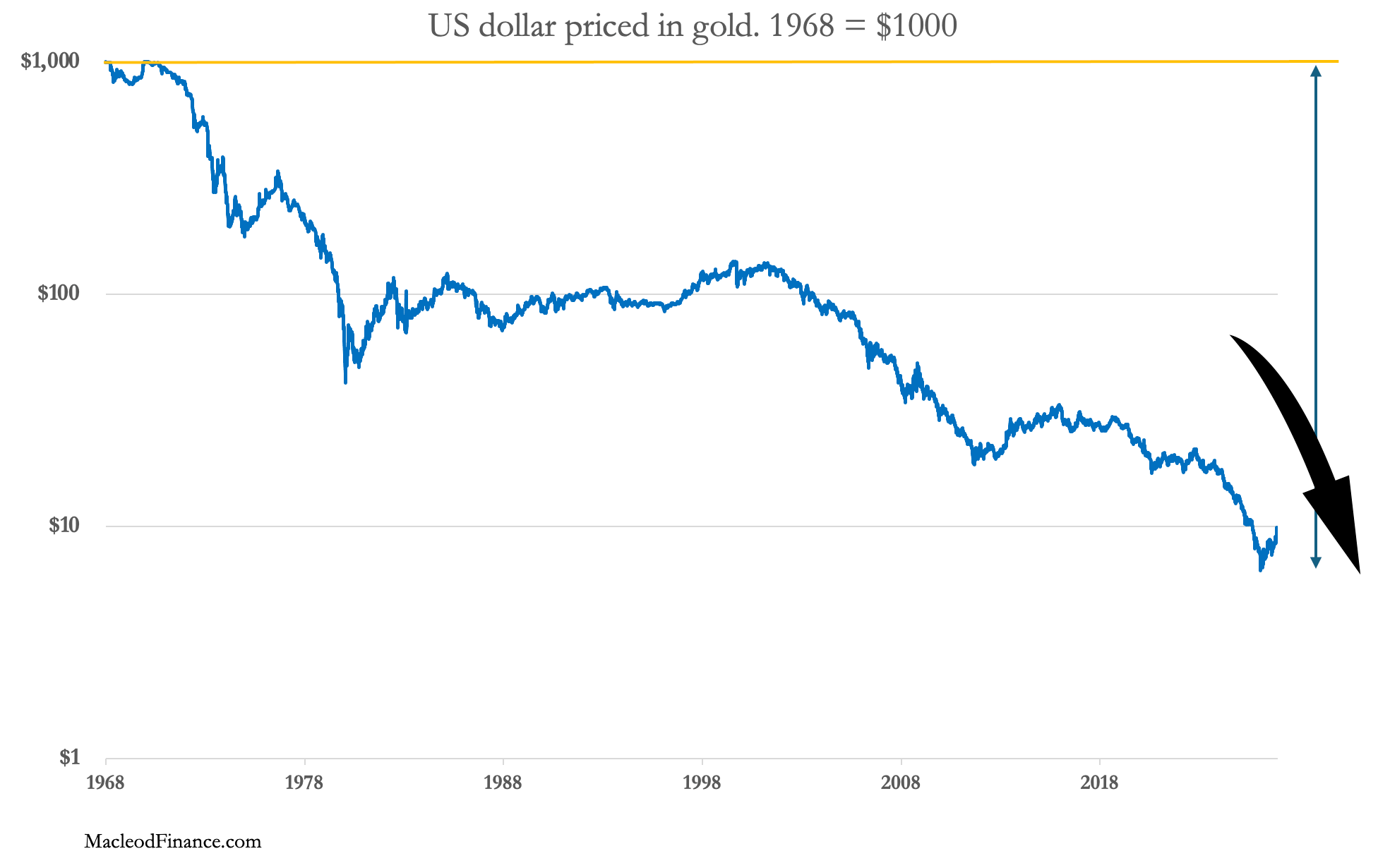
This failure is finally reflected in the collapse in every fiat currency, without exception. The current regime is proving to be no exception as the chart below illustrates, whereby 99% of the dollar’s value has been lost since the London gold pool failed in the 1960s:
This failure even goes back to the 1930s. The US gold standard was first in operation in 1834, when Congress changed the gold-to-silver ratio to set gold at $20.67 per ounce. It was paused during the Civil War, resumed in 1879, then made fully legal by the Gold Standard Act of 1900.
As a result of the newly established Federal Reserve recklessly expanding credit in the mid to late 1920s, the roaring twenties were followed by the Wall Street Crash and the depression. In 1934, the dollar was devalued 40% by President Roosevelt to $35 per ounce. From just before that devaluation to the present day, the dollar has now lost 99.4% of its purchasing power against gold, which is real legal money — not the dollar, which is what most people think. That’s only credit, or imaginary money.
In this article, while the Persian Gulf oil exports remain heavily restricted, we look briefly at the global economic outlook, led by the USA but followed by the G7 and most other nations. We then look at the immediate prospects for the gold price with an emphasis on how investor psychology is influencing it.
