

Introduction
Today’s relationship between money and credit started with the Romans. The first system of Roman law from which modern banking and commercial relationships evolved was the Twelve Tables (or Tablets) of 448 BC, which through subsequent jurists’ rulings established methodical habits of business, and defined value. The Twelve Tables were the foundation of Roman private law. And the fact that even today commercial banks have evolved their businesses on the basis of the Romans’ rulings says something about the durability of banking in its current form. The systemic problems we face today are more the responsibility of a far younger phenomenon — the rise and evolution of central banks.
It is central banks, coordinated by a Bank for International Settlements committee which are trying to develop systems to give the state more control over media of exchange, devising means of directing new forms of credit to enhance the states’ desired objectives, and withholding credit from those deemed disadvantageous to policy. A further evolution of the current system of fiat currencies is intended, which already operate in defiance of Roman and therefore our common laws and which history confirms always fail before reverting to the Roman-based system.
The legal distinctions of money and credit
What interests us in this topic is the system of recording transactions, which following Rome’s Twelve Tables and subsequent juristic findings were divided into two classes, res mancipi, and res nec mancipi. The former referred to a small list of physical property transferred by a formal ceremony of mancipation, or final settlement. It consisted of bronze-copper ingots (the physical form of money at that time), lands and houses on Roman soil, beasts of burden, slaves, agricultural rights, and other rights over land which are res mancipi. By this definition only a bronze-copper ingot weighing a Roman pound, the aes, was corporeal money and the final payment for discharging debt obligations. It was conveyed formally in the presence of five witnesses of full age (cives) and another citizen (librepens) carrying a balancing scale. The aes would be weighed on scales in front of the witnesses and handed to the seller in exchange for goods and to settle outstanding obligations.
Everything else were termed res nec mancipi, including incorporeal debt obligations, which were always entered into to be finally settled in aes in due course. The relationship between money and credit, the latter always the other side of a debt obligation and being subject to final payment was thereby defined in Roman law.
At the time of the Twelve Tables very few Romans were literate, agriculture dominated, and settlement practices reflected society at the time. The strict formalities of a property transfer in res mancipi were abolished by Emperor Leo in 469CE, reflecting the economic and social advances in the eight centuries since the Twelve Tables. Other forms of money, principally the silver denarius and gold aureus coins had entered into use during that time, replacing the earlier aes. The distinction between items confined to res mancipi and res nec mancipi was finally abolished in Justinian’s Pandects in 520CE. Reflecting the rulings of jurists Gaius, then Ulpian and Paulus in the second and third centuries CE, the relationship between money as final settlement and credit with its matching obligation was crystalised in their original relationship.
Jurists were independent wealthy statesmen and legal experts who initially advised the praetors and judges with the approval of the emperor. There is no equivalent of jurists today, but they directly influenced edicts issued by praetors and legal judgements on all matters. In the first two centuries CE, the power of the praetors to create edicts was gradually curtailed and juristic rulings given fuller legal weight. Thus it was that the three jurists particularly associated with the evolution of credit, debt obligations, and security for debt which had become common practice over preceding centuries derived their legal influence. The juristic system was only superseded by the direct authority of the emperor after the third century CE.
Despite these legal evolutions, Roman law firmly established that credit is always the other side of a debt obligation only to be extinguished by final agreement between creditor and debtor. The jurist Gaius (130—180CE) ruled that a debt obligation was strictly personal between debtor and creditor and could only be transferred to another creditor with the agreement of the debtor. Because the Romans had left Britain before Justinian’s Pandects, this was the accepted practice in English common law until the court of common law merged with the Court of Chancery in the 1870s, which had developed the law of equity before being replaced by the Chancery Division. It was this merger in the late-nineteenth century which put an end to the system of qualifying novation whereby a debtor would agree to each transfer to its creditor, unless under the terms of the original contract the debt obligation was agreed to be transferrable at the outset.
Following and contradicting Gaius, Ulpian in the early third century CE ruled that a debt obligation was transferrable between creditors without the debtor’s permission. He recognised the commercial need for a creditor making a loan of property to retain its value to the creditor even though he temporarily lost possession of it. It was formal recognition of a practice which had already been in use between private parties in preceding centuries.
It was Ulpian’s ruling of a creditor’s right to transfer obligations that became incorporated in Justinian’s Pandects (530—533CE). Through the advancement of banking, by common agreement bills of exchange were not required to be indorsed at every transfer, which until well into the nineteenth century was the principal business of banking.
The merger of Courts of Chancery with the court of common law in the 1870s finally did away with the need to indorse transfers, confirming Justinian’s rulings and permitted debt to be valued as wealth in the form of credit in possession. This is the basis of capital markets worldwide to this day.
Debt security
The Romans had two means of ensuring that the relationship between credit and debt would be secured. The first was a personal surety by the debtor, and the second a pledge of a res, an asset of economic value. Roman law with respect to the valuation, possession, and identification of a res formed a considerable body of legal evolution from the earliest days, which are not the focus of our attention. But we should note that these are still the two methods of securing a debt today, underpinning the value of all credit.
Post-Roman common law
Out of the Roman Empire evolved the colonising nations whose common laws were based on Justinian’s Pandects and the later Basilica translation of them into Greek (AD892). Following the global discoveries by Spain and Portugal in the fifteenth and sixteenth centuries, their colonies and those of the colonising nations that followed them all adopted Justinian’s legal distinction between money and credit in their common laws. Spain’s discoveries in the New World brought gold and silver into greater circulation, as did Britain’s guinea from West African gold introduced in 1663, eventually leading to gold replacing silver as the merchants’ favoured final settlement as money.
Following independence, the US adopted UK common law through Blackstone’s Commentaries on the Laws of England, including the inherited relationship between money and credit crystalised in Justinian’s Pandects. And when in evidence to Congress in 1912, John Pierpont Morgan the greatest banker at that time said that “Credit is evidence of banking, but it is not the money itself. Money is gold, and nothing else”, he was stating correctly the legal position defined in common law from Roman times.
The attributes of gold as money
To this day banknotes issued by the Bank of England bear the legend, “I promise to pay the bearer on demand the sum of [the face value of the note]” signed by the chief cashier. It requires the issuer to maintain sufficient stocks of gold in the form of coin or bullion to meet public demand for redemptions of currency and deposits. To suspend conversion of currency and deposits into gold is simply fraudulent in common law.
In the twentieth century, governments began to bend the law, starting with European combatants suspending convertibility of currencies into gold at the outbreak of the First World War. In 1933, America’s President Roosevelt transgressed common law by executive order commanding citizens to submit their gold and gold notes in return for dollars, which he then devalued by 40% the following year. The selective return to international convertibility under the Bretton Woods Agreement was in 1944, which was finally suspended in 1971. Since then, the US Treasury and its central bank embarked on a propaganda campaign to establish dollars as money in place of gold and for all other currencies to regard it as such for international settlements.
But the dollar is never money in common law. It is a broken promise to pay the bearer his right to final settlement in legal money. Since 1971 the dollar has been a fiat currency, fiat meaning it owes its status to the legislation of the country and not to the common law right of private citizens to demand final settlement in gold. The consequence is that the dollar has lost purchasing power against gold so that its value in real money has declined since Bretton Woods was “suspended” from 13.714 grains of gold per dollar ($35 per ounce) to only 0.12 of a grain currently (July 2026).
Credit today
The influence of Roman law embodied in juristic findings incorporated in Justinian’s Pandects and the Eastern Basilica delineates the basis of all our commerce today. Credit is an incorporeal asset still defined as a promise to finally pay in a corporeal asset to which no one else has a claim and includes physical metal. Circulating credit is imaginary money, not money itself. Credit can be settled in other incorporeal promises to pay, a pass-the-parcel of credit-for-credit without final settlement which is almost entirely the basis of modern commerce.
Credit is not restricted to banking. In fact, bank credit is only a minor part of our lives and is central to the entire system of the division of labour. A workman is employed for his skills, expecting payment on completion. He gives his employer credit for his work until the task is done. If he is paid in advance, the employer gives the workman credit to be discharged by his labour.
A parent educating his children by committing to pay school or university fees commits to a series of debt obligations until their education is complete, the creditors being the educational institutions. If he pays these fees in advance, then the institution is the debtor to be discharged by providing the education.
The management of a business has a debt obligation to its shareholders to provide a future stream of returns, for which the shareholders are the creditors. The idea that equities escape the debtor/creditor relationship is incorrect: the relationship still exists, it is the risks to credit’s value which differs. Creditor—debtor relationships of this sort and in the previous paragraph, even if a socialising state intermediates, dwarf the lending of banking systems and commonly escape the attentions of credit analysts.
In all credit relationships, the key is that the value of the debtor’s promise should be tied to a corporeal asset which itself is a medium of exchange, and today that is commonly gold. It is for this reason that a currency issued by a government which denies the relationship eventually fails. And before it fails, its value in terms of goods (corporeal assets in Roman law) and services (incorporeal assets) varies considerably. Figure 1 illustrates this divergence for West Texas Intermediary oil priced in final settlement (gold) and the dollar currency, which is unsettled credit and a debt obligation of the central bank.
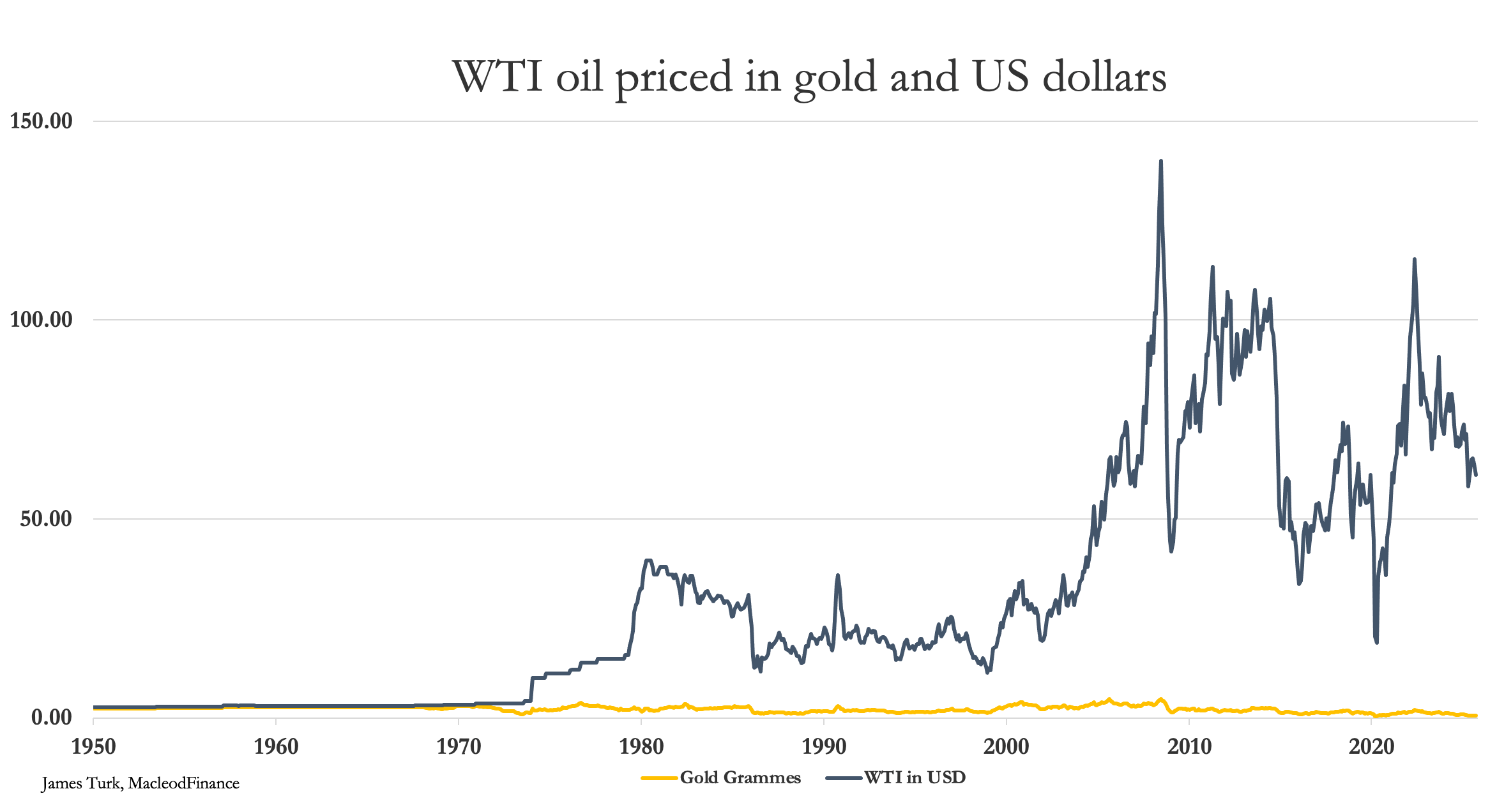
So long as the Bretton Woods Agreement guaranteed that the dollar would act as a gold substitute between nations, the price of oil in gold and the dollar were the same for practical purposes. In other words, the dollar took its value from gold and acted as a gold substitute. Consequently, the oil price varied little in the two decades following the Second World War.
However, the Bretton Woods Agreement led to a run on the US’s gold reserves, reducing them from 20,279.3 tonnes in 1950 to 9,069.7 tonnes in 1971, leading to President Nixon suspending the agreement. No longer a gold substitute, the dollar became a fiat currency from that moment, leading to a decline in its purchasing power reflected in dollar oil prices moving multiples higher with great volatility. The instability of oil priced fiat dollars since the absence of final settlement in gold as a res mancipi since 1971 is plain to see, comparted with oil priced in gold.
The value of all credit, including that of currencies is always a matter of faith. It is true that variations in a currency’s quantity will affect its value. Even though a currency is the objective element in transactions where buyer and seller agree its value and confine price subjectivity to the goods and services being bought or sold, currency units are themselves a commodity which have a value.
Normally, users of a currency will fail to recognise the loss of its value, observing it in changes in the prices of goods and services. This naturally accords with objective and subjective relationships in transactions. But when commodities in aggregate have developed higher values expressed in currency, it is because the purchasing power of the currency has lost value. Not understanding that the currency has lost purchasing power is an error which can persist for some time, demonstrated by the substantial decline in the dollar priced in gold since the Bretton Woods Agreement was abandoned. But like any commodity, if it is not wanted, irrespective of changes in its quantity a currency becomes valueless and the promises of the issuer no longer have credibility.
The only way in which a currency’s credibility can be maintained is for the issuer to ensure that it will always be exchangeable for gold at a fixed weight. And the emergence of new forms of exchange media in future will be subject to the same basic law.